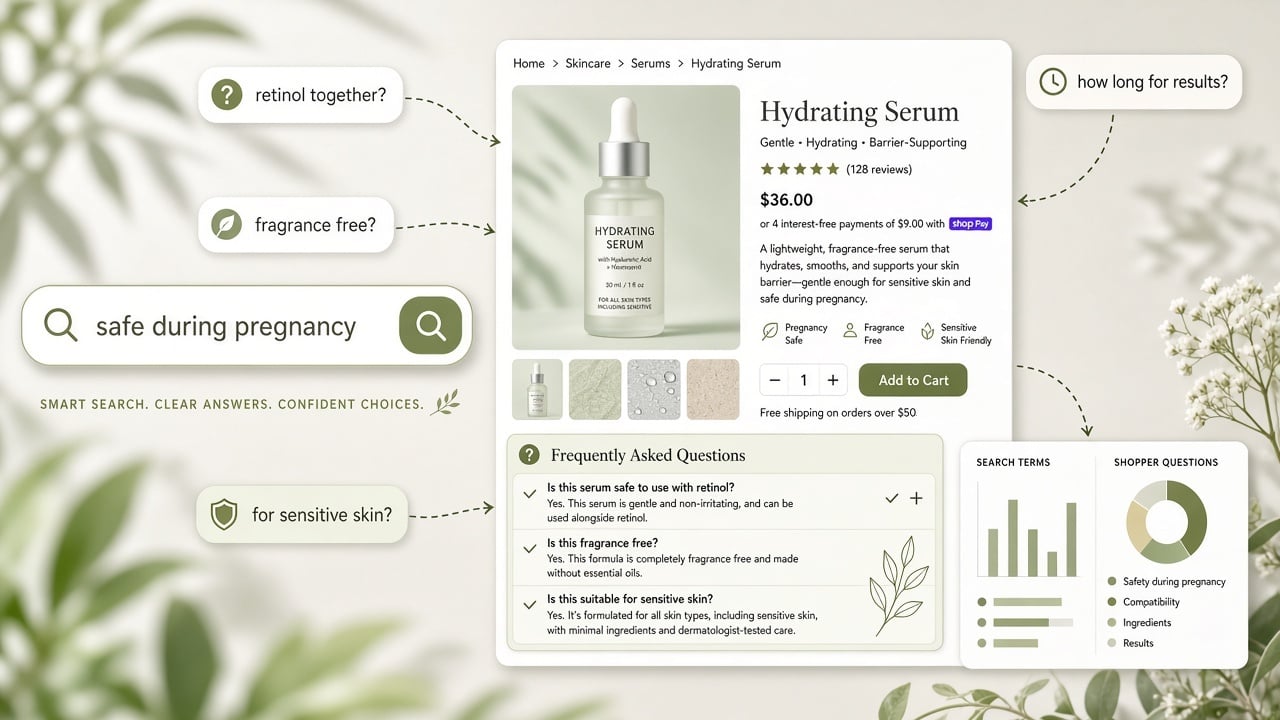
I build selling agents for webshops. Next to the sales, the most useful thing they produce is a list of what people asked before they bought, or before they left. A skincare shopper who types "safe during pregnancy" into your search bar is telling you what your product page forgot to say.
This week, several vendors in our space published comparisons of conversation insight tools. Those tools can help once you have a lot of volume. I think most WooCommerce shops do not need a new subscription to start. They already collect shopper questions in four places, but they never read them together. This guide shows how to do that in a short monthly session, and where skincare shops need to be careful with what they keep.
Where do my shoppers' questions already live?
Look in four places:
- Site search. Every term typed into your search bar is a question in short form.
- Inbox and contact form. Pre-sale emails are the clearest signal, because the shopper cared enough to write.
- Chat transcripts, if you run a chat widget or a selling agent.
- Product reviews and any questions people leave under them.
Each source alone gives a partial view. Read it together and they show the same few doubts coming back again and again.
How do I see my site search terms in Google Analytics?
If your shop already uses Google Analytics 4, you may be collecting search terms without knowing it. GA4 has a setting called enhanced measurement. When its site search option is on, GA4 records an event called view_search_results each time a visitor lands on a results page, and it reads the search term from the web address. By default it looks for five parameters: q, s, search, query and keyword.
Run a search on your own shop and look at the address bar. On many WooCommerce shops the term appears after "?s=, which GA4 already recognizes. If your search plugin uses a different parameter, add it under the advanced settings for site search.
Then open the Events report in the Engagement section, click view_search_results and look at the search terms. Export the last 30 days.
What do I do with the questions once I have them?
Put everything in one sheet with three columns: the question in the shopper's own words, where it came from, and which product it was about. Then group the questions by meaning instead of wording. "Can I use this with retinol", "retinol together?" and "mix with vitamin A" are the same question.
For a skincare shop, you can think of groups about ingredient combinations, fit for a skin type, fragrance and sensitivity, pregnancy and breastfeeding, and how long it takes to see results.
For each group, check one thing: does the product page answer this clearly, near the top, in the words the shopper used? If not, that is your next edit. Write the answer on the page and add it to the product FAQ. If a question keeps coming back for a product that does not suit that shopper, say so plainly on the page. A clear "not suitable for" line may cost you a sale today and can prevent a return later.
The same edits help AI shopping agents. An agent that reads your product page can use what is written there. If the page does not say whether a serum is fragrance free, the agent has to guess or skip your product.
Are skincare questions personal data I need to handle with care?
Note: Always verify by yourself or with your privacy advisor how your use case applies to personal data care.
Yes. Skincare shoppers often explain their situation: eczema, rosacea, a pregnancy, a medication they take. Under the GDPR, data concerning health is personal data about someone's physical or mental health that reveals information about their health status. It is a special category under Article 9, with much stricter rules than ordinary customer data.
The EU Court of Justice reads this broadly. In the Lindenapotheke case in October 2024, it ruled that the details customers enter when ordering pharmacy-only medicines online are health data, even when no prescription is needed, because they link a person to a product and its uses. The seller must explain the processing clearly and ask for explicit consent. Cosmetics are not medicines, and I am not a lawyer. Still, I read that ruling as a warning for any shop that keeps named chat logs where people describe their skin conditions.
For this review you need the question, and you do not need the person. Remove names, email addresses and order numbers before anything goes into the sheet. Keep raw transcripts only as long as you need them, and ask your privacy adviser how your chat tool stores them. Google also requires you to make sure no personally identifiable information is collected in GA4, so check that your search URLs never carry an email address or a name.
What should I do this month?
- Check that site search is on in GA4 enhanced measurement and that your search parameter is recognized.
- Export the last 30 days of search terms, pre-sale emails and chat questions.
- Remove names, email addresses and order numbers.
- Group the questions by meaning and count each group.
- Pick the three biggest groups and fix the product pages they point to.
- Repeat next month and see which groups shrink.
We built CAIDEL to ask shoppers the right questions before the sale and give the merchant the record of what they asked. You can run the first version of this by hand, and I recommend you do, because it shows you exactly what your shop is missing.
Want to try it out? Install CAIDEL for WooCommerce today and enjoy a free trial.

Frequently asked questions
Do I need a conversation insight tool to analyze shopper questions?
Not to start. Site search terms in Google Analytics 4, pre-sale emails, chat transcripts and reviews already hold most of the questions. A tool helps when the volume gets too large to read by hand.
Where can I find site search terms for my WooCommerce shop?
In Google Analytics 4, turn on site search under enhanced measurement, then open the Events report in the Engagement section and look at the view_search_results event and its search terms. GA4 recognizes the "s" parameter that many WooCommerce shops use by default.
Are skincare questions in chat logs health data under the GDPR?
They can be. The GDPR treats data that reveals someone's health status as a special category, and the EU Court of Justice reads that term broadly. Remove names and contact details before you analyze questions, and check your storage with a privacy adviser.
Always verify by yourself or with your privacy advisor how your use case applies to personal data care.
How often should I review shopper questions?
Once a month works for most small shops. It gives you enough questions to see patterns and enough time to check whether your page fixes made a group shrink.